NSCIT

Spotter

A laser rangefinder designed to work with your optical scope, with physical controls and replaceable batteries.

Explore Spotter
$399.00

NSCIT presale

Reserve interest for Spotter

Spotter is currently in presale mode. Join the waitlist with your NSCIT Account and our team will follow up before public ordering opens.

Presale registration open. Notify me when available.

  • Product Documentation
  • Setup & Support Resources
  • Contact Support
  • NSCIT Account follow-up
Presale Follow-up

Spotter is currently in presale. Join the waitlist to reserve interest, receive availability updates, and coordinate configuration details with the NSCIT team.

Product Details
Brand
NSCIT
SKU
spotter-b

Physical controls

A closer look at the buttons on the main unit.

Replaceable power

Supports CR123A or 16340 batteries.

Guidance at hand

Product manuals and a direct route to support.

Rangefinding, integrated

Your optics. More information.

Spotter brings laser ranging and an OLED information display to your optical scope setup. Choose how you measure, read the result and keep the controls within reach.

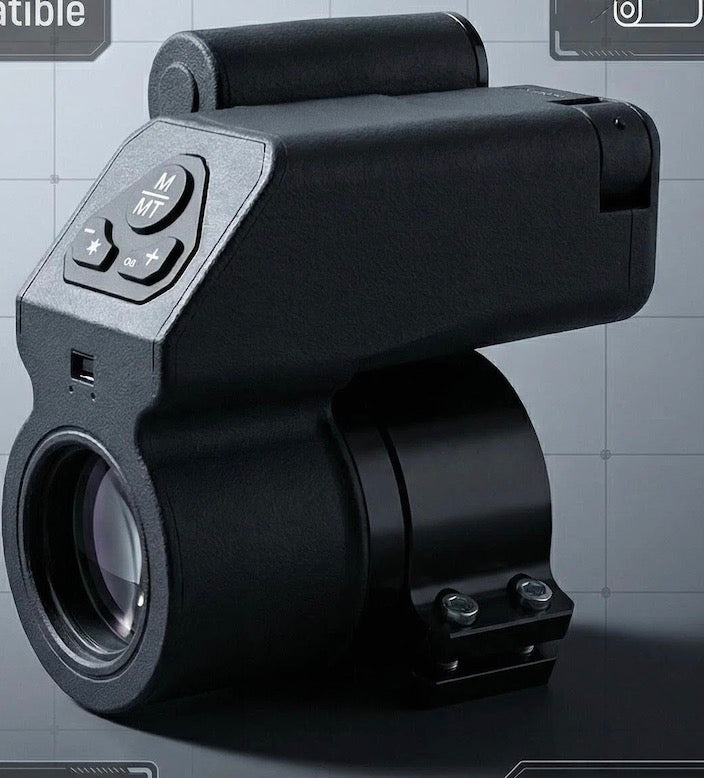
Close view of the Spotter optical opening and housing
Product exterior shown. This photograph is not a view through the display.

Laser ranging

Single and continuous ranging let you choose between one reading and a sequence of updates.

OLED information display

The OLED display presents distance, target mode, incline, level, battery and connection information. Check the measurement and device status in one view.

Control from two places

Use the physical controls on Spotter or its separate Bluetooth remote. The main unit and remote each use replaceable batteries.

Measurement modes

One reading, or keep measuring.

Choose the measurement mode for the task. Spotter also offers three target-selection modes for interpreting multiple returns.

Single ranging

Take a distance reading on demand. A single measurement keeps the operation focused on the result you need at that moment.

Continuous ranging

Keep distance readings updating during a continuous measurement. This gives you a sequence of results instead of one isolated reading.

Three target-selection modes

First, Last and Best determine which return the device prioritizes. They are selection modes, not guarantees that every target will produce a valid reading.

First

Prioritizes the nearest foreground target.

Last

Prioritizes the farthest background target.

Best

Selects the target with the strongest return.

Controls & feedback

Physical controls. Clear choices.

The main-unit buttons and separate remote provide two ways to operate Spotter. The OLED display provides information while you move between measurement and settings.

Side view of the Spotter body and NSCIT logo
01

Main unit and remote

Operate from the unit itself, or use the separate Bluetooth remote in your setup.

Close-up of the physical buttons on Spotter
02

A defined button layout

Physical buttons provide access to ranging and menu navigation. The diopter ring adjusts the viewing focus; refer to the manual for operation.

On-device operation

Use the unit’s physical buttons for measurement and settings, with feedback on the OLED display.

Separate remote

The Bluetooth remote offers another control point within your setup. Its CR1632 battery is replaceable.

Choose familiar units

Distance units are meters or yards; angular units are MRAD or MOA.

Spotter held in a hand, showing the body profile
Handheld product photograph for context. Refer to the specifications for documented measurements.

Body & power

A closer fit with your equipment.

See the unit in hand and plan for its power requirements. Spotter accepts two battery types, so replacements can be prepared independently of the device.

Less than 250 g¹

Weight stated in the current manual. Battery and mounting-component inclusion is not specified.

CR123A / 16340

Supported main-unit battery types. Spotter does not charge batteries internally.

Fit & setup

See the whole setup.

See how Spotter sits alongside an optical scope. Before ordering, confirm the scope model and the required mounting components with our team.

Ask about compatibility
Spotter fitted to an optical scope in an example assembly
Example assembly. Optical scope shown for context; confirm fit and included components before ordering.

Your optical scope

Share the exact scope model and photographs with support so the mounting requirements can be checked.

The mounting components

Confirm the sleeves and other components required for your selected configuration before ordering.

What is included

The assembled optical scope is a demonstration. Check your selected kit for included and separately purchased items.

The unboxing

A first look, out of the box.

Watch the packaging open and take a closer look at the photographed unit and accessories.

Silent unboxing film. The unit and accessories are taken from the packaging and presented together.

The kit
Photographed Spotter kit with main unit, remote, sleeves and printed guide

The photographed kit

The pieces, together.

A closer look at the components shown in this unboxing.

  • Spotter main unit
  • Remote control
  • Mounting sleeves
  • Printed guide

Photographed sample kit. Confirm the supplied components and any separately purchased accessories for your selected configuration before ordering.

Technical specifications

The complete specification view.

Measurement, display, controls, connections, power and physical specifications — grouped for straightforward comparison.

Measurement

Maximum ranging distance
1000 m — manual-rated¹
Minimum ranging distance
To be confirmed
Measurement accuracy
To be confirmed
Range by target type
To be confirmed
Ranging modes
Single / continuous
Target-selection modes
First / Last / Best
Distance units
Meters / yards (m / y)
Measurement principle
Laser ranging
Laser classification
To be confirmed
Laser wavelength
To be confirmed

Display

Display technology
OLED
Angular units
MRAD / MOA
Display resolution
To be confirmed

Controls

Main-unit controls
Physical buttons
Remote control
Separate Bluetooth remote

Connectivity

Wireless connection
Bluetooth
Bluetooth version
To be confirmed
Remote connection range
To be confirmed

Power

Main-unit battery
CR123A / 16340
Remote battery
CR1632
Internal charging
Not supported
Battery life and test conditions
To be confirmed

Body & environment

Weight
< 250 g — manual-rated¹
Dimensions (L × W × H)
To be confirmed
Compatible mounting diameters
To be confirmed
Ingress protection rating
To be confirmed
Operating temperature
To be confirmed
Storage temperature
To be confirmed

¹ Values identified as manual-rated are taken from the current product manual. The manual does not specify target or environmental test conditions for maximum range, or battery and mounting inclusion for weight. Fields marked “To be confirmed” will be updated when verified data is available.

Product manuals

Guidance & support

Keep the guidance close.

Read the product manual for operation and settings, or contact our team for compatibility and order questions.

Product manuals Contact support
Which batteries does Spotter use?

Spotter supports CR123A and 16340 batteries. The unit does not charge batteries internally. The remote uses a CR1632 battery. Follow the supplied manual for battery installation.

How can I check compatibility?

Contact support with your optical scope model and a photo of your setup. Confirm the required mounting components before ordering; the pictured assembly is one example.

Where can I find product guidance?

Visit the product manuals through the link on this page. Contact support if the documentation does not answer your question.

Take another look at Spotter.

Back to product